

Herniated Disc: When Is Surgery Needed and When Is It Not?
A herniated disc is one of the most common diagnoses in spine consultations — and also one of the most misunderstood. Many patients arrive convinced they need surgery when they can actually improve with conservative treatment. Others wait too long when surgery was the right indication from the start. Dr. Ricardo Martínez, spine surgeon in Puerto Vallarta, explains when a herniated disc requires surgery and when it does not.
What Is a Herniated Disc?
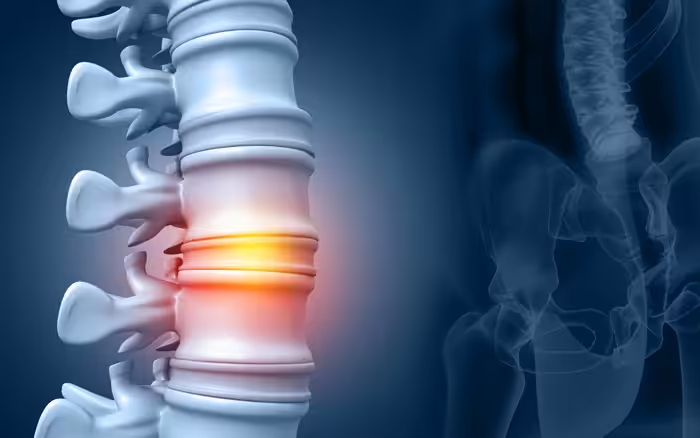
The spine has intervertebral discs between each pair of vertebrae — cushion-shaped structures that absorb impact and allow movement. Each disc has a gel-like core (nucleus pulposus) surrounded by a tough fibrous ring (annulus fibrosus). A herniated disc occurs when that nucleus protrudes or ruptures through the ring, generally toward the spinal canal, where it can compress the spinal cord or nerve roots.
Herniated discs can occur at any level of the spine, but are most common in the lumbar spine (lower back) and the cervical spine (neck). See our section on cervical and lumbar herniated disc for more information on each type.
When Is Surgery NOT Needed for a Herniated Disc?
The vast majority of herniated discs — approximately 80 to 90% — improve with conservative treatment within 6 to 12 weeks. Non-surgical treatment is the first line of management and is indicated when:
- The pain has lasted less than 6 weeks and is not debilitating
- There is no significant loss of muscle strength
- There is no loss of bladder or bowel control
- The patient can perform basic activities with adequate pain management
- Imaging studies show a herniation without severe spinal cord compression
Conservative treatment includes relative rest, anti-inflammatory medications, physical therapy, stabilization exercises, and in some cases epidural corticosteroid injections. With this approach, many patients avoid surgery entirely.
When IS Surgery Needed for a Herniated Disc?
There are situations in which surgery is the correct indication and waiting can have consequences. Surgery is indicated when:
1. Pain does not improve with conservative treatment
If after 6 to 12 weeks of appropriate treatment the pain remains severe and debilitating, surgery is the next option. Continuing to wait in these cases generally does not improve the outcome and unnecessarily prolongs the patient’s suffering.
2. There is progressive neurological deficit
If the patient presents progressive muscle weakness in the arms or legs, this indicates active nerve damage. In these cases surgery must be performed without delay — each week of delay can mean additional neurological damage that may be permanent.
3. Cauda equina syndrome
This is the most important surgical emergency of the lumbar spine. It occurs when a massive herniation compresses the nerve bundle at the lower end of the spinal canal, causing loss of bladder or bowel control, numbness in the genital area (“saddle anesthesia”), and severe weakness in both legs. It requires emergency surgery within the first few hours.
4. Cervical myelopathy
In the cervical spine, a herniation or stenosis compressing the spinal cord can cause myelopathy — progressive deterioration of spinal cord function. Symptoms include clumsiness in the hands, difficulty walking, loss of balance, and in advanced cases paralysis. Decompressive surgery is indicated to stop the deterioration.
5. Recurrent herniated disc
When a patient has improved with conservative treatment but experiences frequent relapses that prevent them from living normally, surgery can offer a definitive solution.
What Type of Surgery Is Performed for a Herniated Disc?
The standard procedure is a discectomy — removal of the disc fragment compressing the nerve. It is currently performed in a minimally invasive manner through small incisions, with fast recovery and hospitalization of 1 to 2 days in most cases.
In the cervical spine, depending on the level and extent of compression, an anterior cervical discectomy and fusion (ACDF) or cervical disc arthroplasty (replacement of the disc with a prosthesis that preserves motion) may be performed.
How Do You Know If Your Herniated Disc Requires Surgery?
The only way to know for certain is through a complete clinical evaluation with a board-certified spine surgeon, supplemented by up-to-date imaging studies (MRI). Dr. Martínez can perform this evaluation in person in Puerto Vallarta or remotely if you send your imaging studies. Contact us to schedule your evaluation.
Frequently Asked Questions about Herniated Disc and Surgery
How long should I wait before considering surgery for a herniated disc?
In general, conservative treatment is recommended for 6 to 12 weeks before considering surgery, as long as there is no progressive neurological deficit or cauda equina syndrome. If there is progressive muscle weakness or loss of bladder or bowel control, surgery must be evaluated immediately.
Can a herniated disc heal without surgery?
In many cases, yes. Between 80 and 90% of patients with a herniated disc improve with conservative treatment within 6 to 12 weeks. The herniated disc can partially reabsorb over time. However, if the pain is severe or there is neurological damage, surgery may be the best option.
How long is recovery from a discectomy?
Most patients operated on with minimally invasive technique walk the same day of surgery and are discharged within 1 to 2 days. Return to light activities occurs between 2 and 4 weeks, and to full physical activities between 6 and 12 weeks depending on the case.
What happens if I don’t have surgery for a herniated disc that requires it?
If there is active nerve compression with neurological deficit and timely surgery is not performed, nerve damage can become permanent. Muscle weakness and numbness that are not treated in time may not fully recover even after surgery.
Not sure whether your herniated disc requires surgery? Schedule an evaluation with Dr. Martínez — in person in Puerto Vallarta or remotely by sending your imaging studies.